We are a premier B2B Lead Generation Agency based in Lehigh Valley, Pennsylvania.
We are a premier B2B Lead Generation Agency based in Lehigh Valley, Pennsylvania.
I’ve watched hundreds of B2B tech sales conversations fall apart in the first five minutes.
Thank you for reading this post, don't forget to subscribe!The rep thinks they’re talking to a technical decision-maker. They lead with architecture benefits, long-term scalability, and innovation potential.
The person on the other end checks out immediately.
Here’s what most sales and marketing teams miss: CTO and VP Engineering are not interchangeable titles. They have fundamentally different priorities, buying criteria, and pain points. When you treat them the same, you alienate at least one of them.
Let me show you exactly how these roles diverge and why your messaging needs to split into two distinct tracks.
The Strategic Visionary vs The Execution Machine
The distinction starts with how each role spends their day.
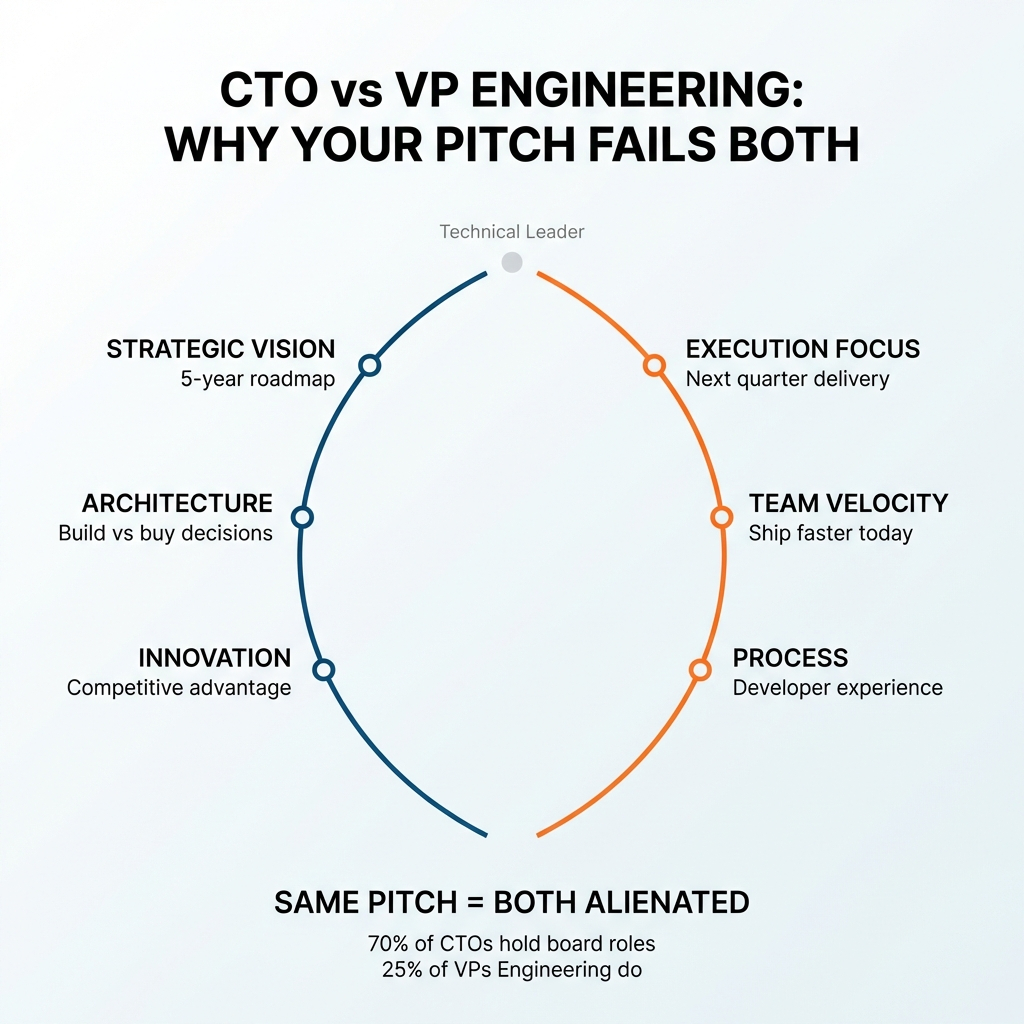
A CTO owns the technical vision of the entire organization. They’re thinking three to five years out. They evaluate emerging technologies, define architectural roadmaps, and align innovation with business strategy.
A VP Engineering focuses on the operational reality of building and shipping software. They manage teams, optimize processes, and balance the constant tension between velocity and quality.
The data backs this up. Research shows that 70% of CTOs hold board-level directorship roles, compared to just 25% of VPs Engineering. That’s not a small gap. It reflects fundamentally different strategic responsibilities.
When I work with tech companies on their outreach strategy, this distinction becomes critical. Your messaging needs to speak directly to what keeps each role up at night.
What CTOs Actually Care About
CTOs evaluate solutions through a strategic lens.
They’re asking questions like:
Does this align with our long-term technical architecture?
Will this create or reduce technical debt five years from now?
How does this position us competitively in our market?
What’s the total cost of ownership over the product lifecycle?
One of the most consequential decisions CTOs face is the build versus buy decision. Get it right, and you accelerate competitive advantage while optimizing costs. Get it wrong, and you waste millions while delaying critical initiatives.
CTOs think in systems and ecosystems. They care about API flexibility, integration capabilities, and how your solution fits into their broader technical stack. They want to understand your product roadmap and where you’re investing R&D resources.
When you’re targeting CTOs, your messaging should emphasize:
Architectural flexibility and future-proofing
Strategic alignment with business objectives
Long-term ROI and TCO analysis
Innovation potential and competitive differentiation
Security, compliance, and risk mitigation
Your sales conversations need to happen at a strategic altitude. Skip the feature dump. Focus on how your solution enables their vision.
What VP Engineering Actually Cares About
VPs Engineering live in a different reality.
They’re managing delivery timelines, sprint velocity, and team performance. They’re balancing product roadmaps against engineering capacity. They’re solving for today and next quarter, not next decade.
Their questions sound completely different:
How quickly can we implement this?
Will this slow down our current development velocity?
What’s the learning curve for my team?
How does this impact our ability to ship features on schedule?
What support and documentation do you provide?
VPs Engineering optimize for momentum. They need solutions that help their teams ship faster without sacrificing quality. They care about developer experience, onboarding time, and how your tool integrates into existing workflows.
When you’re targeting VPs Engineering, your messaging should emphasize:
Implementation speed and time-to-value
Team productivity and developer experience
Process optimization and workflow efficiency
Clear documentation and support resources
Measurable impact on delivery metrics
Your sales conversations need to be tactical and specific. Show them exactly how your solution solves their immediate operational challenges.
The Buying Process Looks Completely Different
Understanding role differences matters most when you map the actual buying journey.
CTOs typically enter the conversation earlier in the evaluation process. They’re involved in defining requirements, evaluating strategic fit, and making build versus buy decisions. They care about vendor stability, long-term partnerships, and strategic alignment.
VPs Engineering often get pulled in during the implementation and integration phase. They’re evaluating practical considerations like team adoption, technical integration complexity, and impact on current projects.
Here’s where most sales strategies break down: You send the same pitch deck to both roles. You use identical email sequences. You position the same benefits in discovery calls.
The CTO sees operational details and thinks you don’t understand strategic value. The VP Engineering sees high-level vision and thinks you don’t understand their daily reality.
You need two distinct messaging tracks that speak directly to each role’s priorities and pain points.
How To Actually Fix Your Targeting
Start by auditing your current approach.
Look at your website copy, sales decks, email templates, and demo scripts. Ask yourself: Am I speaking to strategic vision or operational execution?
For CTO-focused messaging:
Lead with business outcomes and strategic impact
Emphasize architectural considerations and long-term value
Provide detailed technical documentation and integration capabilities
Share case studies focused on competitive advantage and innovation
Discuss partnership potential and product roadmap alignment
For VP Engineering-focused messaging:
Lead with implementation speed and team productivity
Emphasize ease of use and developer experience
Provide clear onboarding resources and support options
Share case studies focused on velocity improvements and efficiency gains
Discuss specific workflow integrations and process optimizations
Your outreach sequences should reflect these differences from the first touchpoint. Your LinkedIn messages, cold emails, and discovery call frameworks need to adapt based on who you’re targeting.
The Practical Reality For Your Sales Team
I work with B2B tech companies on lead generation and appointment setting every week. The teams that consistently book high-quality meetings understand this targeting distinction.
They segment their prospect lists by role. They customize messaging based on priorities. They train SDRs to recognize the difference in discovery conversations.
The companies that struggle treat all technical decision-makers the same. They wonder why their conversion rates stay flat despite increasing outreach volume.
Your ICP needs to account for role-specific buying behaviors. Your CRM should track these distinctions. Your sales enablement materials should provide role-specific talk tracks.
This isn’t about creating more work. It’s about creating more relevant conversations that actually convert.
What This Means For Your Pipeline
When you align your messaging with how CTOs and VPs Engineering actually buy, several things happen:
Your email response rates improve because prospects feel understood. Your discovery calls go deeper because you’re asking relevant questions. Your close rates increase because you’re addressing actual priorities.
You stop wasting time on conversations that were misaligned from the start.
Most importantly, you build credibility with technical buyers. They recognize that you understand their world. That credibility translates into trust, which translates into closed deals and long-term relationships.
The B2B tech buying process is complex enough without adding unnecessary friction. When you speak directly to what each role cares about, you remove that friction and accelerate the entire sales cycle.
Start by reviewing your next ten outbound sequences. Identify whether you’re targeting a CTO or VP Engineering. Adjust your messaging accordingly. Track the difference in response rates.
The data will speak for itself.
Comments